
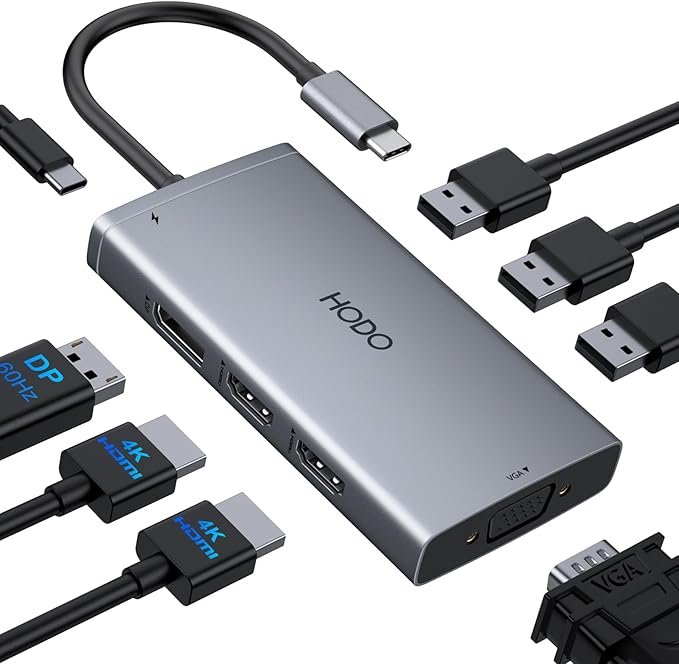

USB C Docking Station Dual Monitor Adapter
| Brand | HODO |
| Color | Grey 8 Port USB C Docking Station |
| Hardware Interface | HDMI, Thunderbolt, USB 2.0, USB Type C, VGA |
| Special Feature | Fast Charging, Fast Data Transfer, Heat Resistant, Plug and Play |
| Compatible Devices | Work with the Laptop has thunderbolt |
About this item
USB C Docking Station Dual Monitor Adapter
The USB‑C Docking Station Dual Monitor Adapter is a versatile accessory that expands the capabilities of laptops, tablets, and other USB‑C devices. It allows you to connect dual external monitors along with peripherals such as keyboards, mice, Ethernet, USB drives, and more — transforming a single USB‑C port into a full workstation hub. This makes it ideal for remote work, content creation, presentations, and productivity setups.
Design & Build Quality
This docking station typically features a compact and lightweight design that fits easily on a desk or in a laptop bag for travel. The housing is usually durable plastic or aluminum, offering a balance between strength and portability. Ports are clearly labeled, and the layout is designed to reduce cable clutter. Most models include ventilation or heat dissipating design to maintain stable performance during extended use.
Ports & Connectivity
A typical USB‑C Docking Station Dual Monitor Adapter includes:
Dual video outputs such as HDMI and/or DisplayPort for connecting two external displays
USB‑A ports for keyboards, mice, flash drives, and other peripherals
USB‑C data ports for additional devices
Ethernet port for wired network connection
Audio jack for headphones or speakers
SD/MicroSD card slots on some models
This wide range of ports turns a single USB‑C connection into a full productivity hub.
Display & Performance
The main highlight is dual monitor support. The adapter typically allows you to run two external screens simultaneously at high resolutions such as 1080p or 4K, depending on the model and your device’s capabilities. Dual monitor setups enhance productivity by expanding your workspace — useful for multitasking, spreadsheet work, video editing, and presentations. The connection usually supports smooth video output with minimal latency when properly configured.
Compatibility
USB‑C docking stations are commonly compatible with a wide range of devices that support USB‑C with DisplayPort Alternate Mode or Thunderbolt. This includes many modern laptops, tablets, and smartphones. However, compatibility and features (like dual display support) can vary depending on the device’s specifications. Some devices may limit video output or power delivery capability.
Setup & Ease of Use
Setting up the adapter is generally simple:
Plug the USB‑C connector into your device.
Connect external monitors to the designated video output ports.
Attach peripherals like keyboard, mouse, or storage devices.
Adjust display settings on your device’s operating system to extend or duplicate screens.
No complex software is typically required, and many docking stations are plug‑and‑play once your device supports the necessary USB‑C standards.
Pros & Cons
| Pros | Cons |
|---|---|
| Expands single USB‑C port into multiple useful ports | Dual monitor support depends on device compatibility |
| Allows dual external display connection | Some models may require high‑spec graphics support |
| Useful for productivity and workstation setup | May draw power from device without delivering power back |
| Supports peripherals like USB drives, keyboard, mouse | Not all models support 4K on both displays simultaneously |
| Ethernet and audio connectivity enhance utility | Can be bulky compared to simple dongles |
Who Should Buy It?
Recommended For:
Remote workers needing a full workstation setup
Students and professionals using multiple displays
Content creators and video editors
Users wanting more ports without clutter
Not Ideal For:
Users whose device lacks USB‑C video output support
Those needing only a single additional port (simple dongle may suffice)
Users looking for ultra‑compact travel solutions without monitors