
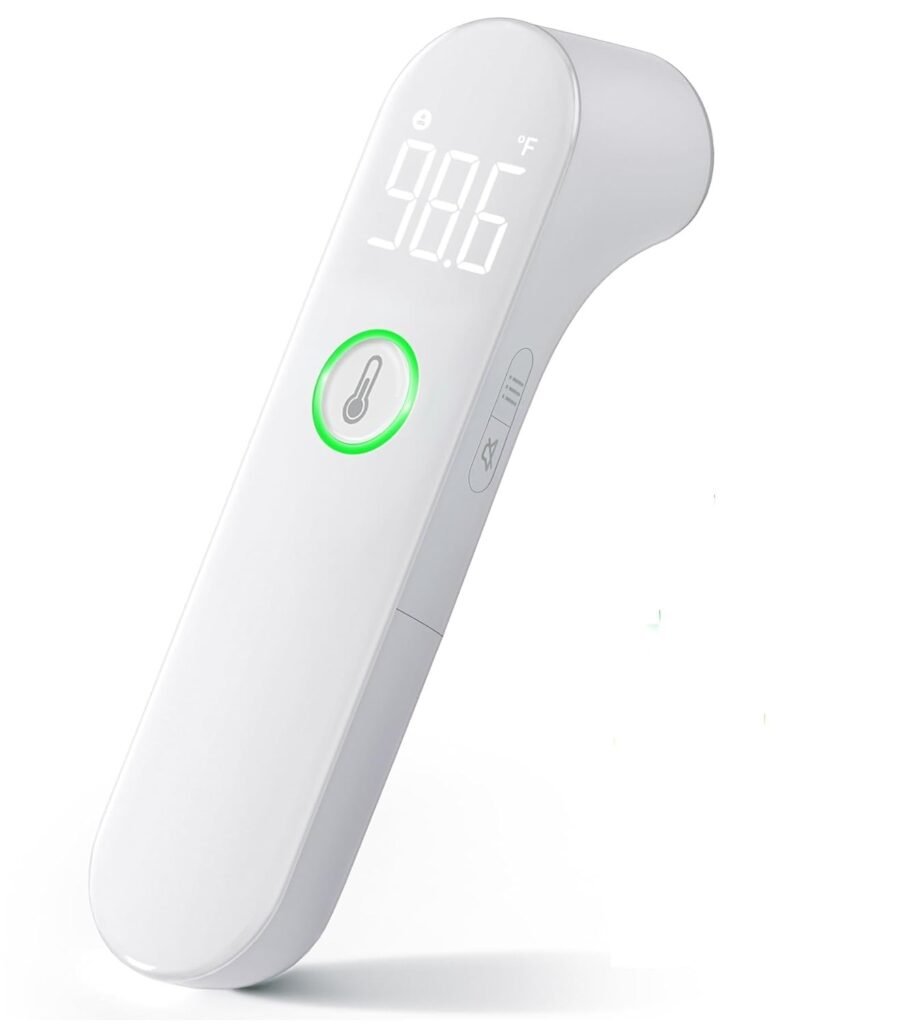

Thermometer for Adults and Kids
| Brand | Viproud |
| Special Feature | Baby essentials / Newborn essentials must haves, Fast Reading System, High Accuracy, Large Display, Non-Contact, Ultra Clear ScreenBaby essentials / Newborn essentials must haves, Fast Reading System, High Accuracy, Large Display, Non-Contact, Ultra Clear Screen |
| Color | White |
| Age Range (Description) | Adult & Kid & Baby |
| Included Components | 1* Thermometer, 2* AAA Battery, 1* Pouch, Instruction Manual, Quick Start Guide |
| Outer Material | Plastic |
| Specification Met | Fda / Ce / Fsa / Hsa |
| Display Type | Digital |
About this item
Thermometer for Adults and Kids
A Thermometer for Adults and Kids is an essential household health device that helps you quickly and accurately measure body temperature for fever detection, illness tracking, and wellness monitoring. Whether you’re checking a child’s temperature during a cold or monitoring adult health, a reliable thermometer makes health checks simple, fast, and stress-free.
This review will cover key features, accuracy, ease of use, performance, pros and cons, and practical recommendations for families and individuals.
Key Specifications
| Feature | Details |
|---|---|
| Product | Thermometer for Adults and Kids |
| Measurement Type | Digital infrared / oral / ear / forehead (model dependent) |
| Accuracy | Precise readings with small tolerance |
| Speed | Fast measurement (usually 1–3 seconds) |
| Display | Digital LCD/LED |
| Units | °C and °F selectable |
| Memory | Last reading recall (model dependent) |
| Use Cases | Adults, children, infants |
| Power | Battery powered |
| Safety | Non-invasive or contact measurement |
Design & Build Quality
Thermometers designed for both adults and kids usually feature an ergonomic shape, comfortable grip, and clear display for easy readouts. Non-invasive infrared forehead models are popular for families since they read temperature quickly without discomfort. Ear thermometers offer precise internal measurements, while digital oral thermometers provide reliable all-around use.
The device materials are typically medical-grade and safe, suitable for repeated home use.
Accuracy & Performance
Accuracy is the most important metric for any health thermometer. Good models provide precise readings within a small deviation range, ensuring you can rely on the results for health decisions.
Types and performance:
Infrared Forehead: Fast, non-contact measurement ideal for kids and sleeping patients
Ear (Tympanic): Accurate internal measurement when fitted correctly
Oral/Underarm: Traditional contact method with reliable consistency
Many digital thermometers display results within a few seconds, which is especially useful for wiggly children or quick checks.
Ease of Use & Interface
Thermometers for adults and kids are designed to be simple and intuitive:
Power on the device
Select unit (°C or °F)
Position thermometer appropriately
Wait for beep or signal
Read the displayed temperature
Large, backlit displays make reading easy in all lighting conditions. Some models store the last few results, helping you track temperature changes over time.
Safety & Hygiene
Family-friendly thermometers often come with protective probe covers or non-contact sensors, reducing the risk of cross-contamination. Cleaning is easy — usually a soft cloth or alcohol wipe is enough — making them practical for busy households.
Pros & Cons
| Pros | Cons |
|---|---|
| Fast, accurate readings | Accuracy varies slightly by type |
| Suitable for all ages | Requires correct positioning |
| Easy digital display | Batteries need replacement |
| Non-invasive options available | Some models cost more |
| Memory recall for trend tracking | Not a substitute for medical diagnosis |
| °C and °F selectable | Ear models require proper fit |
Who Is It For?
This thermometer is perfect for:
Families with children and adults
Home health monitoring during flu or cold seasons
Caregivers and parents needing quick checks
Travel and portable health kits
It’s designed for general wellness use and basic fever detection, not as a clinical medical device.